UMS Carl Sagan
The UMS Carl Sagan is a Beta-class research vessel owned and operated by the University of Mare Serenitatis. It is the flagship of the university's research fleet and represents a significant institutional investment in deep-space scientific capability.
The Sagan's current mission is a pre-colonization archaeological survey of Mars, led by Professor Alexandros Leonidas.
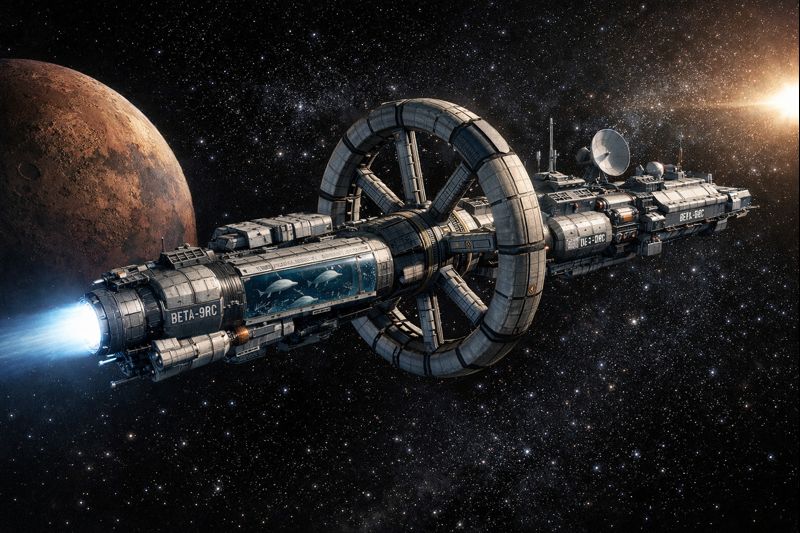
The Ship
Classification and Capabilities
The Carl Sagan is a medium-sized Beta-class vessel optimized for extended research missions. Unlike military Beta-class ships configured for combat or force projection, the Sagan prioritizes laboratory space, sensor arrays, and crew comfort for long-duration operations.
Key specifications:
- Class: Beta (medium-range research variant)
- Operating range: Long-range capable; designed for inner-system operations without infrastructure support
- Crew capacity: 16-20 (current mission: 14)
- Rotating section: Single torus providing Earth-standard gravity for crew quarters, medical bay, and primary laboratories
- Cetacean facilities: Dedicated dolphin habitat tank, pilot-cabin integration, mobile tank for ship transit
Layout:
The Sagan follows standard Beta-class architecture: a central spine with the fusion drive at the rear, cargo and zero-gee operations modules along the spine, and a rotating torus section for crew habitation. The ship is configured for cetacean/human hybrid operation.
- Spine (zero-gee): Bridge, cargo holds, sensor arrays, communications suite, engineering, dolphin habitat and pilot cabin
- Torus (rotating): Crew quarters, galley, medical bay, primary research laboratories, mission planning room, recreation space
Naming Tradition
The University of Mare Serenitatis names its research vessels after famous scientists. The Carl Sagan was commissioned in 2371 and represents the university's commitment to ambitious research programs. The name honors the 20th-century astronomer and science communicator who advocated for both rigorous scientific skepticism and the search for extraterrestrial life — a fitting patron for a ship investigating claims of pre-human intelligence on Mars.
The Mission
Objectives
The Mars Archaeological Survey has dual objectives reflecting different institutional priorities:
Primary (Scientific): Investigate Professor Leonidas's claims of artificial elements in historical Mars rover samples. Conduct systematic archaeological survey of sites identified through Leonidas's research. Document and recover any artifacts of potential xenoarchaeological significance.
Secondary (Institutional): Assess potential colony sites for the anticipated Mars settlement. Evaluate water ice deposits, geothermal resources, and habitability factors. Produce reports that will inform the university's position in the coming Mars charter negotiations.
These objectives exist in tension. Time and resources devoted to archaeology cannot be spent on colonization assessment, and vice versa. The mission leadership must balance scientific discovery against institutional investment.
Political Context
Mars is the prize of the current era. UEF, Luna, and corporate interests are all jockeying for position in the anticipated colony charter. The University of Mare Serenitatis is betting that early scientific presence — both archaeological discovery and colonization groundwork — will translate into educational authority and institutional prestige when the colony becomes reality.
Professor Leonidas's claims of pre-human artifacts add an unpredictable element. If he's wrong, the university has backed an embarrassing failure. If he's right, the implications are world-changing — and whoever controls access to alien artifacts will have enormous leverage.
Timeline
The mission is planned for approximately 3-4 months:
- Transit to Mars: ~3.5 days (average orbital position)
- Mars operations: 10-12 weeks
- Phobos Station coordination: Ongoing throughout Mars operations
- Return transit: ~3.5 days
Crew Roster
Command and Bridge
- Captain Pravitha Iyer — Ship's Captain
- See detailed profile below.
- Captain Splishy Splashy — Primary Pilot
- See detailed profile below.
- [Pilot PC] — Co-Pilot
- Full telepath and empath. Former service with Splishy; saved the dolphin's life during a mission gone wrong. Their bond is deep and tested.
- [Rin Jeong] — Security Officer / Sensors
- Belter, empath. Mispahk survivor. Ship security (shipboard and groundside), backup on sensors. Native Belt modifications plus enhanced clotting and toxin tolerance. Met Victoria McKinley on Ceres. After rehabilitation, took coursework at University of Mare Serenitatis (security focus, sensors minor), where she deepened her friendship with Kai.
- Kyle Chen — Communications Officer
- See detailed profile below.
Engineering
- Kai Le Gerrac — Chief Engineer
- Promoted to chief for this mission. Third-generation hybrid descendant — his grandfather was a stable survivor of the gene-modification era. The hybrid lineage left Kai with a genetic anomaly that Venn Life Sciences found fascinating: his genome is unusually flexible and resilient, taking to modifications more successfully than average. A visible side effect is that his cosmetic mods blend seamlessly into his natural skin rather than showing the subtle seams common in others. Enrolled as a child in a Venn longitudinal study that treated an inherited condition and tracked his development through adulthood. Unknowing kinetic — his Talent manifested subtly during an electrical accident, deflecting a lethal discharge. He believes he was simply lucky. Engineering degree with a minor in archaeology; has a "Natural Engineer" trait that gives him unusual versatility across engineering disciplines. Went through Fleet Basic Training with the Pilot PC and Victoria McKinley; met the Pilot at a concert before they enlisted together. Helped get the Pilot to rehabilitation on Ceres after the boarding incident, where they both met Rin.
- Dr. Yuki Tanaka — Engineering Support
- Fusion systems specialist. Quiet, methodical, prefers machines to people.
- Marcus Webb — Engineering Support
- General maintenance and repair. Former merchant marine, practical and unflappable.
Research
- Professor Alexandros Leonidas — Mission Principal Investigator
- See detailed profile below.
- Victoria McKinley — Medical Staff / Linguistics
- Empath with psychometry. University of Mare Serenitatis alumnus. Was serving on Ceres when UEF called her in to examine Tiamat remains — selected because she had the right expertise and was already on site. Has limited clearance and carries heavy secrets. Linguistics capability will prove valuable. Went through Fleet Basic Training with the Pilot PC and Kai Le Gerrac. Met Rin Jeong while serving on Ceres.
- Dr. Osei Mensah — Materials Science / Physics
- Expert in exotic materials analysis. Here to verify (or debunk) Leonidas's "artificial elements" claims. Skeptical but fair-minded.
- Dr. Fatima Al-Rashid — Geologist
- Mars surface specialist. More interested in the planet's natural history than potential aliens, but professional enough to follow the evidence.
- Noor Hadid — Colonization Assessment Specialist
- See detailed profile below.
Key NPCs
Captain Pravitha Iyer
Role: Ship's Captain
Background: Lunar, Indian descent, late 40s
Pravitha Iyer commands the Carl Sagan with the quiet competence of someone who has spent decades earning her place. She presents as practically feminine — comfortable with she/her pronouns but with an angular, no-nonsense bearing that doesn't perform for anyone's comfort.
History:
Pravitha and Leonidas were students together at Mare Serenitatis. Where he went straight into academia, she chose Service — not because she lacked the mind for research, but because she wanted to be an explorer, not an academic. She wanted to stand on new ground, not write papers about it.
Her Fleet career took her to the outer system. Survey missions, patrol routes, the kind of work that let her see the solar system firsthand. She rose through the ranks on competence and an explorer's hunger. When the University commissioned the Carl Sagan, she jumped at the chance to command it. Research expeditions are the closest thing to pure exploration left.
She doesn't know that Leonidas applied back-channel pressure to help her get the position. The qualifications were all hers — but so were several other candidates'. Leonidas tipped the scales. If she ever finds out, it will complicate their relationship enormously.
Relationship with Leonidas:
They argue like an old married couple and trust each other with their lives.
The friction is real: Leonidas thinks she wasted her potential, that she could have been a brilliant researcher but "settled" for being a ship captain. She thinks he doesn't understand what it means to want the experience of discovery, not just the analysis of it.
Both are a little right and a little wrong. Underneath, she's proud of him and he's proud of her, and neither would ever admit it directly.
There's also an undercurrent she doesn't fully acknowledge: Leonidas is spectacularly, visibly Talented. She is not Talented at all. She has worked twice as hard for half the recognition, and while she doesn't resent him personally, she resents the unfairness of it.
Beliefs:
- My crew is my responsibility. I will bring them home — all of them.
- I became a spacer to stand on new ground, not to read about it. This mission will take me somewhere no one has been.
- I earned this command. No one gave it to me, and no one can take it from me.
Instincts:
- Always know where my crew is.
- When Leonidas pushes too hard, I push back.
- When in doubt, trust my ship.
At the table:
- Professional and competent; runs a tight ship without being rigid
- Dry humor, often at Leonidas's expense
- Genuinely cares about her crew's wellbeing
- Will butt heads with Leonidas over risk assessment — her job is to bring everyone home
- The jealousy over his Talent is subtle; she'd never admit it even to herself
- The third Belief is a landmine: if she discovers Leonidas helped her get this command, it will shake her sense of identity
Professor Alexandros Leonidas
Role: Mission Principal Investigator
Background: Greek descent, early 50s, kinetic Talent (K6 official / K9 actual)
Alexandros Leonidas is the driving force behind this mission — a xenoarchaeologist who has spent decades arguing that humanity is not alone in the solar system's history, and who now has a chance to prove it.
The Theory:
Leonidas claims to have identified artificial elements in historical Mars rover samples — isotope ratios and molecular structures that could not have formed naturally. He believes these are evidence of pre-human intelligence on Mars. The scientific establishment largely dismissed him as a crank until the University of Mare Serenitatis staked its reputation on backing him.
He also believes Talent has always existed in humanity, pointing to historical accounts of "miracles" and "psychic phenomena" as evidence of unrecognized Talents throughout history. This theory is less controversial but still contested.
The Talent:
Leonidas is officially rated K6 — already exceptional. His actual capability is K9, making him one of the most powerful kinetics alive. He specializes in macrokinesis and can move enormous masses with precision. However, he has a persistent mental block against microkinesis; the fine manipulation that would be invaluable in his archaeological work frustrates him endlessly.
Personality:
Leonidas is driven, obsessive, and genuinely difficult to work with. He is also extremely charming, a brilliant lecturer, and a compelling author. He's the kind of scientist who would be too much trouble for most institutions — but he delivers results, attracts critical students, and brings in funding. The university knows exactly what they have.
He has enemies. Within the university administration, colleagues who resent his special treatment. Across the scientific community, researchers who consider him a publicity-seeking crank. He projects indifference to this criticism, but it grates on him more than he admits. He knows he's right, and soon everyone else will too.
The name "Leonidas" is a family name, but he'd be lying if he said he didn't glory in it a little. Holding the line against ignorance. Defending truth against overwhelming odds. It appeals to him.
Beliefs:
- The evidence is on Mars. I will find it, and when I do, no one will ever dismiss me again.
- Talent is humanity's birthright, not a mutation to be feared. I will prove we have always been more than we knew.
- I will drag humanity into the truth, whether they're ready or not.
Instincts:
- Always position myself between danger and my students.
- When someone dismisses my work, I make them regret it.
- When I'm frustrated, I move things.
At the table:
- Charismatic and persuasive when he wants something
- Dismissive and impatient when he doesn't see the point
- Genuinely brilliant — his insights are real, his methodology is sound
- Treats Noor Hadid (the colonization specialist) as an unwanted imposition
- His relationship with Pravitha is the most human thing about him
- The microkinesis block is a genuine frustration; he may ask kinetic PCs for help
- The third Instinct means objects shift when he's angry or stuck — a tell that reveals his power level and can be intimidating or alarming
Captain Splishy Splashy
Role: Primary Pilot
Background: Dolphin, age unknown (dolphins don't track age the way humans do)
Splishy is a dolphin pilot — which means, by Fleet convention, he holds the rank of Captain regardless of his actual position in the command structure. He takes orders from the mission CO but has no command authority over others. This suits him fine.
Why He's Here:
Splishy completed his Service years ago. He found military ships a bit boring — too much waiting, not enough going. What drives him is exploration. He wants to see the farthest reaches of the solar system, and maybe someday, beyond.
The Carl Sagan's mission to Mars interested him. But that's not the whole story.
Relationship with the Pilot PC:
Splishy and the Pilot PC served together previously, and the PC saved Splishy's life when a mission went catastrophically wrong. This creates a bond that goes beyond professional respect. Splishy trusts the PC with his life — because he already owes them his life.
Their pilot dynamic is still being established. They may swap primary/co-pilot roles depending on the situation, or develop their own rhythm. The PC's telepathic/empathic abilities add a dimension to their coordination that purely human pilot teams can't match.
Personality:
Splishy is a joker. Puns, specifically. He delights in wordplay that makes humans groan, and his telepathic delivery adds layers of meaning that make the jokes either better or worse depending on your tolerance.
But underneath the humor is a genuine explorer's soul. He describes space in terms of flow and current, thinks in motion and geometry, and notices things that human spatial awareness misses. When things get serious, the jokes stop and the competence shows.
Beliefs:
- I will see what no dolphin has ever seen.
- [Pilot PC] brought me back from the dark. I will not fail them.
- The deep memory stirs for a reason. I will learn what the whales cannot say.
Instincts:
- When the ship moves wrong, correct it before thinking.
- Always answer tension with a joke.
- When something feels important, remember it for the whales.
At the table:
- Constant puns; lean into it or suffer
- Describes navigation in fluid, almost poetic terms — "we'll ride the gravity gradient down"
- Deadly competent when stakes are high
- Protective of his co-pilot; that debt is real
- May receive communications or intuitions from cetaceans that he has to interpret
- His tank/cabin is a social space; crew often visit to decompress
- The third Belief and Instinct overlap intentionally — the cetacean responsibility is woven through how he thinks and acts
Kyle Chen
Role: Communications Officer
Background: American Midwest / Chinese descent, mid-30s, career Fleet
Kyle Chen is the Sagan's communications officer — reliable, professional, and quietly competent. He handles ship-to-ship communications, long-range transmissions to Phobos Station and Earth, and the communications suite's integration with the sensor arrays.
Personality:
Kyle is the kind of crewmate everyone appreciates but nobody thinks about much. He's friendly, reliable, and good at his job. He remembers birthdays, covers shifts without complaint, and always seems to know what's happening on the ship without being intrusive about it.
He grew up in the American Midwest before his family relocated to Tycho, which left him with a faint accent that surfaces when he's relaxed and a genuine appreciation for both Earth and Luna. He joined Fleet because it seemed like the right thing to do, and stayed because he was good at it.
Off-duty, he's pleasant company — interested in other people's stories, easy to talk to, never dominates a conversation. He has opinions but doesn't push them. The kind of person you'd trust to watch your belongings but might struggle to describe in detail afterward.
At the table:
- Friendly and helpful; never refuses a reasonable request
- Good listener; remembers details from previous conversations
- Tends to be around during important moments — he's attentive to ship rhythms
- Professional under pressure; doesn't panic, doesn't grandstand
Noor Hadid
Role: Colonization Assessment Specialist
Background: Middle Eastern/North African descent, late 20s
Noor Hadid is the university's representative for colonization planning — and Professor Leonidas considers them an unwanted imposition.
The Role:
The University of Mare Serenitatis isn't just funding Leonidas's archaeological passion project. They're making a strategic investment in Mars's future, and they want return on that investment. Noor's job is to assess potential colony sites, evaluate resources and habitability, and produce reports that will influence where the colony charter lands.
This means water ice surveys, geothermal mapping, atmospheric sampling, infrastructure assessment. Work that requires time and resources — time and resources that Leonidas wants spent on archaeology.
The Friction:
Noor has no idea that Leonidas considers them an intrusion. They genuinely believe their work and his work are complementary: "We're both here to understand Mars better!" They're eager to help, eager to learn, eager to contribute.
Leonidas... does not share this view. Every hour Noor spends on colonization assessment is an hour not spent looking for evidence of pre-human intelligence. He sees them as a babysitter imposed by administrators who don't understand what's really at stake.
The crew will have to navigate this tension. Noor's enthusiasm is genuine and infectious; so is Leonidas's irritation.
Personality:
Noor has golden retriever energy. They're happy. They're eager. They believe — in Mars, in the colony, in humanity's future as a spacefaring species. And they are determined to do a good job, because this mission is a huge opportunity for someone their age.
They're not naive. They understand politics, institutional pressures, competing priorities. But they approach these challenges with optimism rather than cynicism. Problems are things to be solved, not complained about.
If they ever realize that Leonidas sees them as an unwelcome burden, they'll be crushed. But they might also rise to the occasion — their determination runs deep.
Beliefs:
- Mars is humanity's next great step. I will help make it happen.
- This is my chance to prove myself. I will not waste it.
- Professor Leonidas and I are on the same side, even if he doesn't see it yet.
Instincts:
- Always volunteer to help.
- When someone's upset, try to fix it.
- Start each day with a plan.
At the table:
- Enthusiastic about everything; genuinely interested in the PCs' work
- Will volunteer to help with anything, sometimes getting in the way
- Surprisingly competent when given clear tasks
- Their optimism can be grating or refreshing depending on the moment
- If Leonidas finds alien artifacts, Noor's reaction is worth playing out — wonder? fear? sudden realization that colonization plans need to account for this?
- A potential ally for PCs who need someone without hidden agendas
- The first Instinct means they'll insert themselves into situations where they're not needed — play this for both comedy and occasional genuine usefulness
Supporting Crew
These characters are sketched rather than fully developed; details can be added as needed.
- Dr. Yuki Tanaka — Engineering Support
- Fusion systems specialist. Quiet, methodical, prefers machines to people. Respects competence; will warm to the Chief Engineer PC if they prove capable.
- Marcus Webb — Engineering Support
- General maintenance and repair. Former merchant marine, has seen everything, surprised by nothing. Practical, unflappable, good in a crisis.
- Dr. Osei Mensah — Materials Science / Physics
- Here to analyze Leonidas's "artificial elements" claims. Skeptical but intellectually honest — he'll follow the evidence wherever it leads. Dry sense of humor.
- Dr. Fatima Al-Rashid — Geologist
- Mars surface specialist. More interested in the planet's natural history than aliens, but professional. Has a friendly rivalry with Noor over whose work is more important.
Connected NPCs
Characters with significant ties to the crew who are not aboard the Sagan.
Silence Before Dawn
Role: Researcher, University of Mare Serenitatis Center for Talent Research
Background: Orca, tenured research professor
Silence Before Dawn is a senior researcher at the University of Mare Serenitatis' Center for Talent Research and Development, specializing in telepathic trauma response and the psychology of Talent manifestation. Her work focuses on two related questions: why human telepaths struggle with trauma in ways cetaceans do not, and how to ease the often-violent initial manifestation of telepathic Talent in humans.
Research Focus:
Cetacean telepathy is intuitive, lifelong, and integrated into their experience from birth. Human telepathy typically manifests suddenly, often explosively, and frequently in response to stress or trauma. The disconnect between "having always been telepathic" and "becoming telepathic" fascinated Silence — she approached human telepathic trauma as an outsider trying to understand a problem her people never faced.
Her breakthrough came through collaboration with a human patient and later colleague: the Pilot PC. Traditional therapeutic techniques had failed to address trauma from a boarding incident that had shattered the Pilot's psychological defenses. Working together, they developed an approach drawing on Goetic symbolic frameworks — a medieval human tradition of externalizing and binding psychological forces — adapted for telepathic and empathic work.
The technique treats intrusive thoughts, trauma responses, and dissociated psychological elements as externalized entities to be named, evoked, negotiated with, and ultimately integrated rather than suppressed. The telepath-therapist and patient work together in a shared mental space, giving form to what the patient struggles to face alone. The empath component allows the therapist to sense the patient's true emotional relationship to these externalized elements, navigating around the defenses patients construct even against themselves.
Their co-authored paper on the technique has gained attention in Talent research circles, though it remains controversial. Critics question whether the approach constitutes therapeutic support or invasive mental manipulation — a distinction that may depend entirely on consent and intent.
Personality:
Silence Before Dawn embodies her name: patient, observant, and comfortable with long stillness before decisive action. She listens more than she speaks, and when she does communicate, her telepathic presence carries the cold clarity of deep water — precise, unhurried, and difficult to deflect.
She does not pretend to be anything other than a predator. Her interest in human psychology is genuine but carries an edge of the clinical — she studies damaged minds the way she might study wounded prey, understanding their patterns with the patience of a hunter who knows that understanding precedes effective action. This is not cruelty; it is simply what she is. Her therapeutic work is no less caring for being predatory in approach.
Her relationship with the Pilot PC evolved from researcher/subject to mentor/student to something approaching equals. She respects what they survived, takes pride in the technique they developed together, and maintains the relationship as colleague and friend. The bond is genuine, though expressed in orca terms — loyalty demonstrated through action rather than sentiment.
At the table:
- Available for consultation (with appropriate lag)
- May provide insight into telepathic/empathic challenges the crew faces
- Her predator nature should come through in how she frames problems — she thinks in terms of patience, positioning, and the decisive moment
- The technique she and the Pilot developed could be relevant if crew members face psychological trauma during the mission
- She has connections throughout the Talent research community and could facilitate introductions or provide background on other researchers
Related
- Story — campaign starting hook and current events
- Mysteries — what the mission will discover
- Technology — ship classes and capabilities
- Cetaceans — dolphin pilots and cetacean interests
- Talent — kinetic abilities and ratings